On the surface, using comparison sites to generate leads seems great. They capture high-intent traffic from homemovers who are actively searching for removal firms. Why wouldn’t you sign up? You’re showing up right when the customer is looking to book. Perfect, right?
Not quite.
The customer is likely looking for a solution quickly. If you’re busy moving someone, you may not get around to calling them until later that evening, in which case, it may be too late. Or perhaps the customer is inputting their data at 8pm, by which time you’ve clocked out, tired after a busy day of moving a 5-bed home. Another firm that didn’t have a move that day or has a dedicated employee dealing with lead generation has already contacted the lead and booked them in. You’re too late, you’ve missed that lead. The money you’ve paid to be on that comparison site has gone to waste.
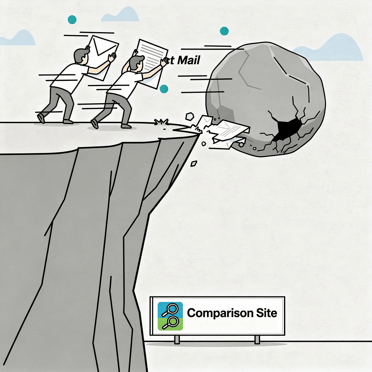
A better solution is to beat the customer to the chase. Get in front of them before they open up their laptop or scroll on their phone seeking out comparison sites. How? By sending direct mail to customers that you know are in the homemoving journey. MoverAlerts can help you with that. We know exactly who is in the moving journey and what stage they’re at. We can either provide you with a list of homemover addresses or carry out a full direct mail campaign on your behalf.
Now, perhaps you were the first removal firm to contact that comparison site lead. That doesn’t mean you’ll win the lead either. You’re now just one of many removers phoning the customer up. And when those phone calls start rolling in, customers get annoyed at being bombarded with calls from every firm fighting for their custom. Some customers stop answering after one or two calls. If they do answer, you’re likely faced with a hostile reception as the customer is quite frankly fed up of it all. You’ve paid a pretty penny for the lead, and you may not even get a chance to speak to the customer if they stop answering. Even though the customer knowingly provided their details, it feels like cold calling.
If the customer does answer your call and is still interested, what then? Likely, they’ll tell you they’ve received a cheaper quote, and you’ll get sucked into race-to-the-bottom fee-chasing to win the client.
Direct mail, on the other hand, is warm and friendly; it’s not intrusive like a phone call. The client is given the chance to peruse your postcard and call you at their leisure. There’s no pressure. And you can maintain your fees at your standard rate because you’re not suddenly in a fee-war over the phone.
When customers see your call as a nuisance, this translates to low trust in your brand. Direct mail on the other hand is seen as higher value. You’ve taken the time to create the piece of mail. You’ve paid to have it printed and posted. This instantly shows the customer that you invest in your company, and thus, your company is perceived as professional, not intrusive. The care that you take to create the postcard translates to the care you’ll take in looking after their belongings. That’s one of the key benefits of direct mail – it builds trust.
The Harvard Business Review states that trust is one of the foundations of business, and without trust, you cannot create relationships with customers. Trust is essential in your industry as you’re dealing with people’s belongings, their heirlooms and their memories. According to Marketreach, direct mail is the most trusted channel, with 54% of people trusting it. This is compared to 35% for phone calls. Why?
- It’s easier to verify who the sender is compared to a phone call
- It allows the customer to engage on their own terms without any pressure or urgency
- It’s tangible, i.e. you can hold it and interact with it
- It captures attention and offers a certain novelty, as well as being informative
- The tactility of a postcard also creates a sense of exclusivity
- It feels more personable and believable
Research commissioned by Royal Mail and conducted by Millward Brown found direct mail leaves a "deeper footprint on the brain compared to virtual, digital alternatives.” Through direct mail, your brand becomes memorable and trustworthy.
In terms of brand awareness, direct mail wins there, too. According to JICMAIL, the average direct mail item is interacted with for 143 seconds by anyone in the household across 28 days. That’s your brand being noticed and interacted with by a high-intent customer. Movers can retain your postcard, pop it on the fridge or on their paperwork pile to refer back to. This is far more powerful than any phone call could ever be.
Conclusion
When the lead enters their details on a comparison site, the situation that ensues feels like a group of sharks circling a fish. Only the quickest and cheapest will get to the lead first, and the rest are left hungry. Forget this cutthroat approach to finding customers. There is an easier way! Rather than waiting for the customer to seek you out, get in front of them first with direct mail marketing from MoverAlerts.
With comparison sites, every lead is instantly shared with multiple competitors, forcing you to compete on price or speed of response. By contrast, a traditional direct mail approach allows you to reach movers proactively, giving you space to stand out and showcase your value. You can build a connection before anyone else. This lowers competition, increases conversion and puts you in control.
If you’re interested in finding out more about our homemover data and marketing campaigns, get in touch here!